Visiting hours today: 09:00 - 20:00, last entry Castle Grounds Tour 18:30, Historical Tour 16:30

Research Centre for Post-Teutonic Order Heritage

News

The 10th anniversary of the unveiling of the Madonna statue
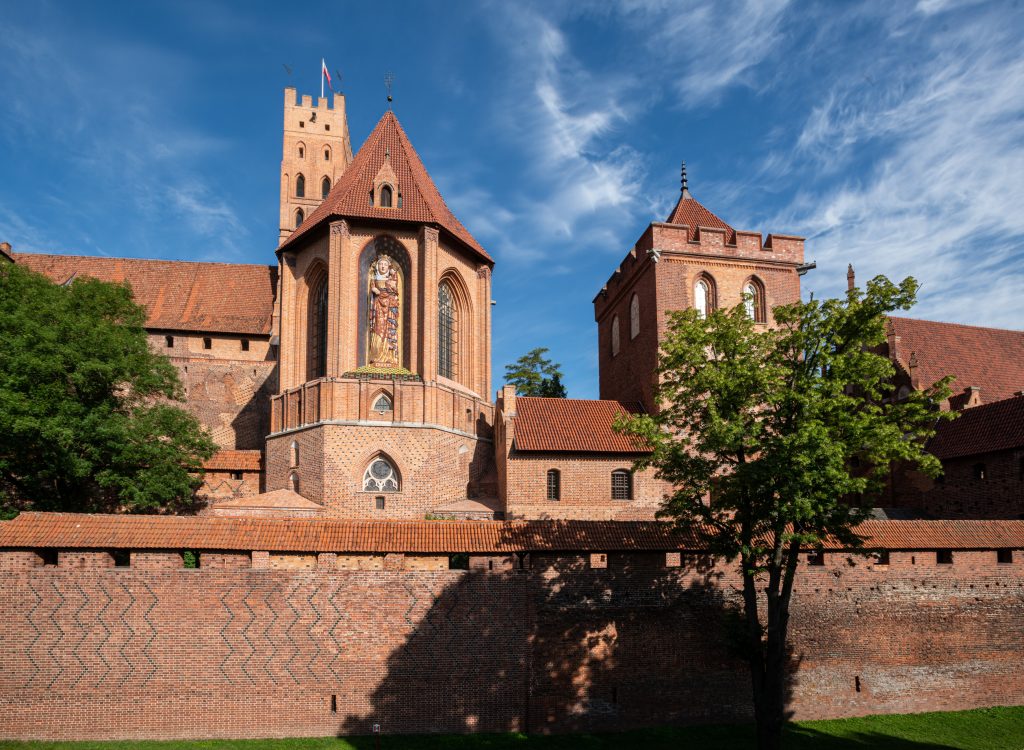
10 years since the return of the Madonna – the story of the destruction, reconstruction and restoration of Malbork’s symbol
It is now 10 years since the statue of the Madonna – one of the town’s most important symbols – was unveiled once again on the walls of Malbork Castle. Its return in 2016 was not only the culmination of many years of conservation work, but also an event of immense historical and social significance.
However, this is not merely a story of reconstruction. It is the tale of a work of art that towered over the castle for centuries, was destroyed during the war, and returned to its rightful place several decades later.

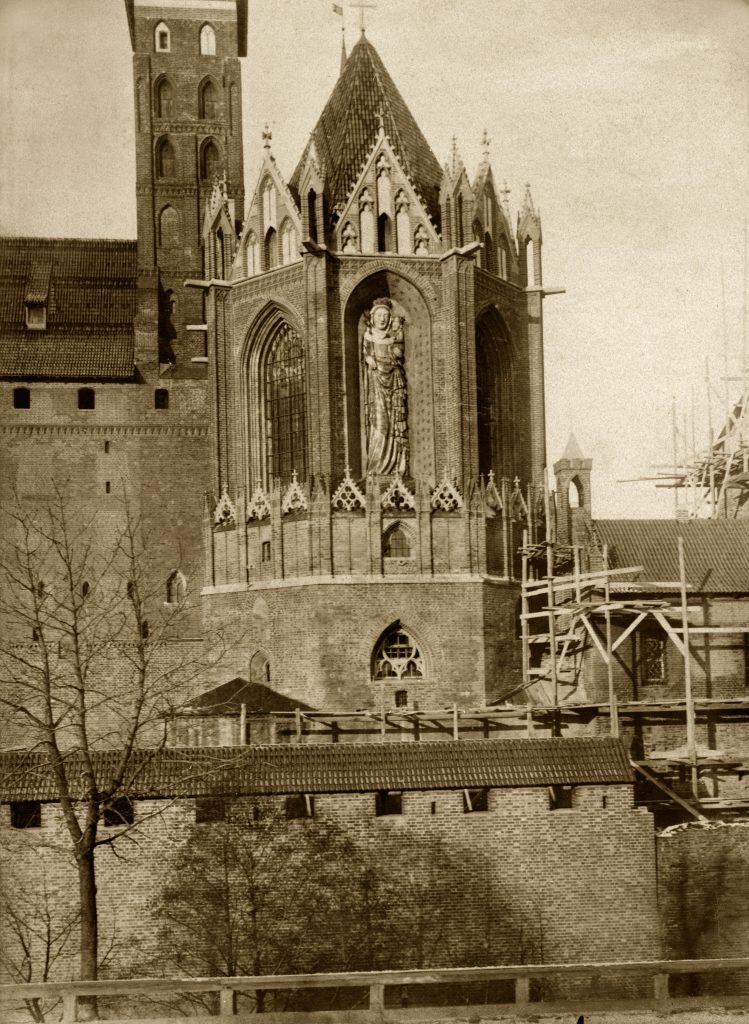
Figura Madonny z roku 1895
A medieval masterpiece and unique technology

The statue of the Virgin Mary was placed here around 1340, in a niche in the eastern apse of the church at the High Castle. The technique used to create it was remarkable for its time. Individual segments were cast directly at the place from a gypsum-lime mortar mixed with gravel aggregate. These parts were then anchored to the wall using long metal rods.


Originally, the figure was covered with a layer of paint made from natural pigments and adhesive techniques. Difficult weather conditions caused the paint to degrade over time – it flaked and lost its colour intensity.


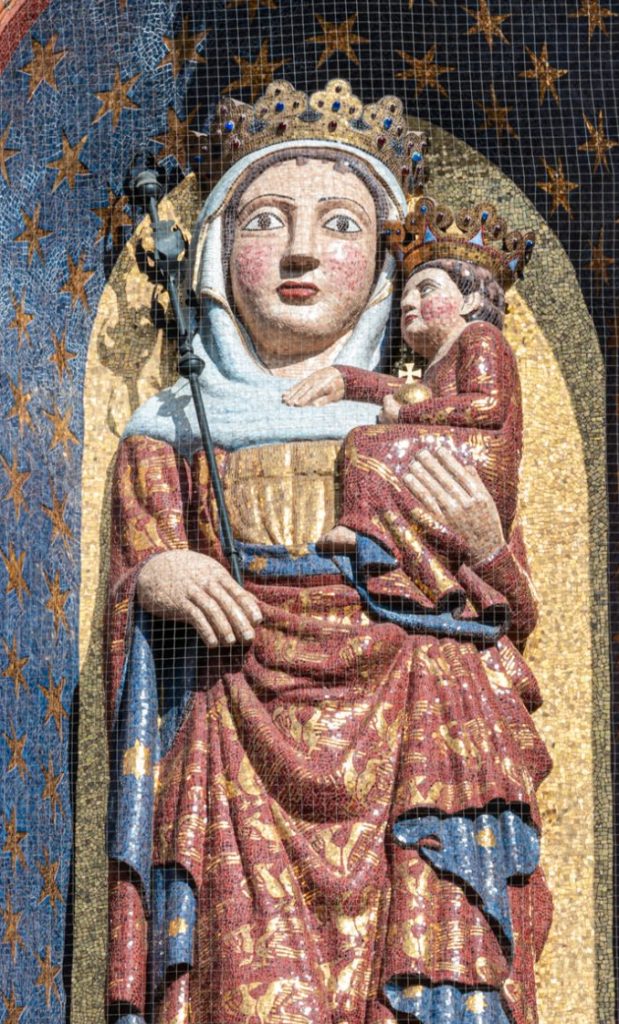
A turning point came around 1380, when the decision was made to cover the figure with a mosaic. This was a pioneering solution – previously unknown north of the Alps, and even less so in a three-dimensional form. A master craftsman from the Venice area, a place where mosaic techniques had reached the highest level of development, was invited to carry out the work.

The result was a monumental composition which adorned the castle for centuries to come, becoming one of the most recognisable features of its silhouette.

Destruction in 1945

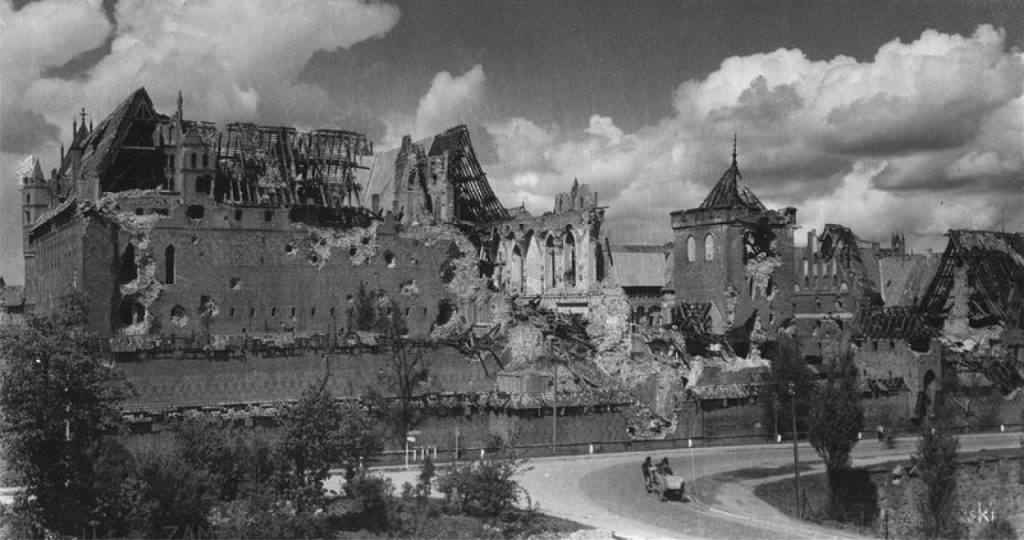
The statue’s history was brutally cut short in February 1945. As a result of the war, it collapsed along with the church wall. The structure broke into pieces; some were damaged, but many parts survived.

The recovered parts were extracted from the rubble and stored for a long time in various places within the castle, including the cellars of the Grand Masters’ Palace. For decades, they were a testament to a lost heritage.

Zniszczony zamek po 1945
The path to reconstruction

The breakthrough did not come until the 21st century. The Mater Dei Foundation was established in 2007 to raise funds for the reconstruction, later donated by the museum as its contribution to the EEA project.

At first, it was suggested to create a modern replica, with the original parts to be put on display in the museum. Ultimately, the decision was made to carry out a reconstruction using the surviving parts and to restore the statue to its original place.

The project was funded through a combination of funds raised by the foundation as well as European and Norwegian funding.

Reconstruction – precision and respect for history

Conservation work began in 2014. The surviving parts were taken to the workshop, where they were reinforced and reassembled. They were often broken into smaller pieces, which required immense precision and expertise from the conservators.

The segments were then gradually reassembled in the historic niche: exactly where the figure had stood before its destruction in 1945.

One of the most important stages was the reconstruction of the mosaic. The original medieval parts were not preserved to a degree that would allow their reuse, so a new mosaic was created, faithfully reproducing the historical design based on iconography.

The materials came from two sources:

• the coloured glass (including reds and blues) was made in Italy,
• the gold parts were made in Gdańsk.

The Return of the symbol

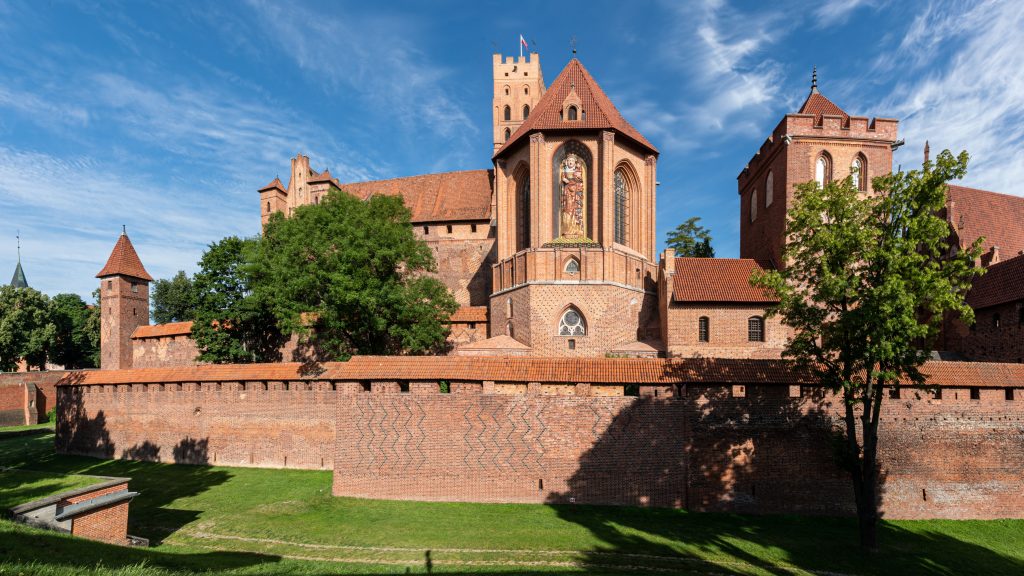
In April 2016, following the completion of the work, the Madonna returned to her place. After more than 70 years of absence, she once again became an integral part of the castle’s panorama.

Today, the statue not only adorns Malbork Castle, but also symbolises the continuity of history, the determination to rebuild, and the strength of the local community. Its reconstruction is an example of how a combination of conservation expertise, community engagement and institutional support can bring priceless heritage back to life.

Tickets

Buy tickets online

Opening Hours

  • Mon:9:00 - 20:00
Exhibitions
  • Tue - Sun:9:00 - 19:00

Contact

Tourist Information

  • +48 55 647 08 00
  • +48 55 647 09 02
  • +48 55 647 09 78