Stained-glass panels
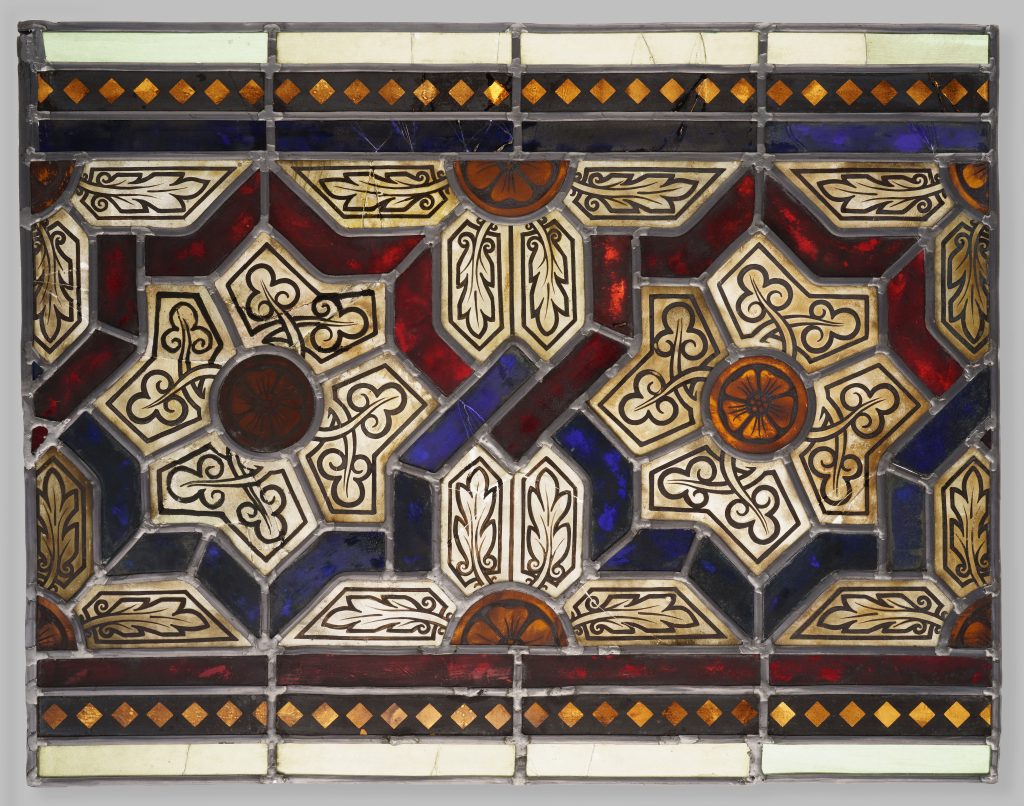
The stained-glass panels in question, each measuring approx. 66 x 52 cm (H x W), form a design consisting of two eight-pointed stars arranged vertically, framed by a border on the right and left. In the central part of each star there is a circular medallion with a five-petalled flower painted on it, surrounded by four irregularly shaped fields with a painted motif of two crossed three-leafed twigs. Both stars are surrounded by rhomboidal or irregularly shaped tiles and framed by a corner arrangement consisting of three tiles, in which two, pentagonal or hexagonal in shape, are covered with a painted design of a stylised oak leaf, and the third, in the shape of a quarter-circle, adheres directly to the border. he border consists of three narrow rectangular bands, the central band painted with rhombuses in an ornamental cord pattern.
History
An attempt to catalogue the castle’s stained-glass windows reveals that the 19th century provides the most data in the form of archival material and iconography. This was linked to the idea of rebuilding Malbork Castle in the late 18th and early 19th centuries to make it… the pantheon of the Prussian province, the Prussian Westminster. During this time a large-scale construction and conservation project was launched, with the approval and financial support of the highest state authorities, the elite of Prussian officials, and the entire community, which took a keen interest in the progress of the work in Malbork.
As a result, in 1819 the first medieval stained-glass windows arrived in Malbork, purchased to adorn the Church of the Blessed Virgin Mary at the High Castle. These included panels dating from the 14th century from the demolished Dominican Church of St Nicholas in Toruń, and an unspecified number of panels from the Franciscan Church of the Blessed Virgin Mary in Toruń (dating from the last quarter of the 14th century). In 1888, further stained-glass panels were purchased, including those from the Church of the Assumption of the Blessed Virgin Mary in Chełmno and additional stained-glass panels from the Franciscan church in Toruń. An unknown number of medieval stained-glass panels were purchased in 1898 from the Church of the Blessed Virgin Mary in Toruń (featuring ornamental and figural motifs).
The recovered stained-glass panels most likely date from the late 19th century and were ordered by the Malbork Castle Reconstruction Board from Johann Baptist Haselberger of Leipzig. They were intended to complement the purchased medieval panels.
Ultimately only specialist research can unequivocally determine the age of these artefacts.
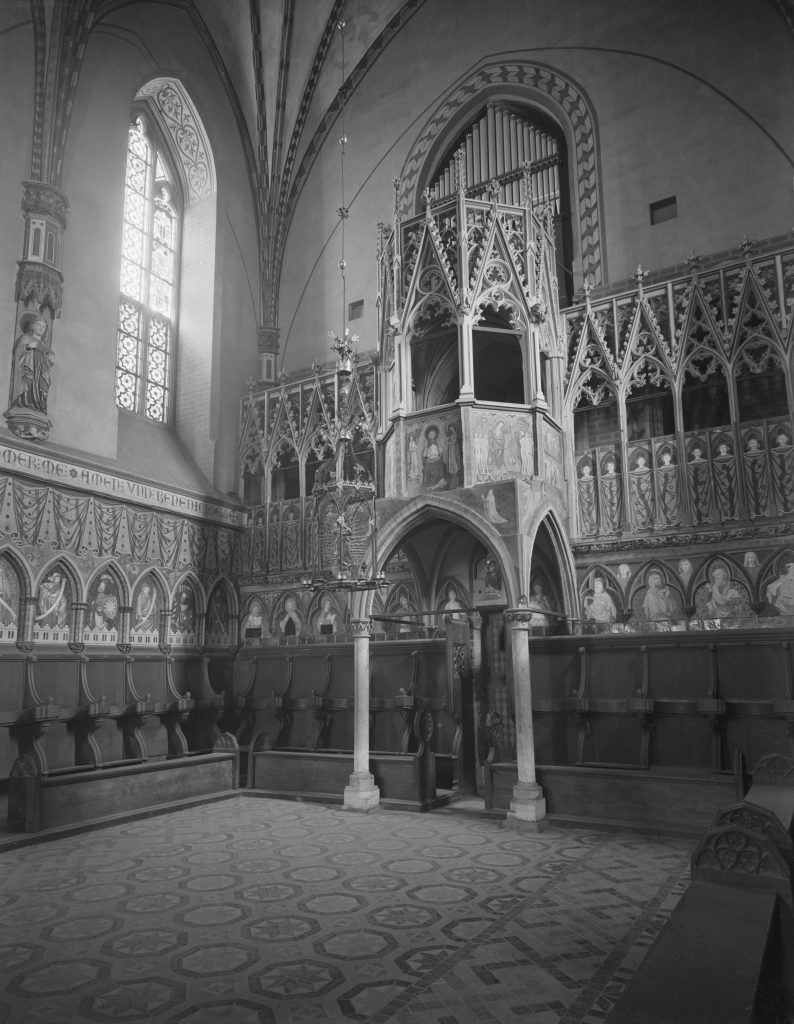
The first window on the south wall of the castle church (counting from the west) contained stained-glass panels with figural scenes: on the left, an image of Our Lady of Sorrows; on the right, a scene of the Flagellation of Christ (both figures crowned with architectural canopies), complemented by panels featuring a star motif. Conrad Steinbrecht’s inventory drawing from 1882, held in the State Archives in Gdańsk, depicts the window of interest to us, with the remains of medieval Toruń stained-glass panels brought to Malbork. In total, this particular window contained six 14th-century panels, including one with a motif of two eight-pointed stars. The remaining fields were filled with 19th-century copies featuring a repeated star motif, as documented by an archival photograph from the 1930s held by Bildarchiv Foto Marburg.